
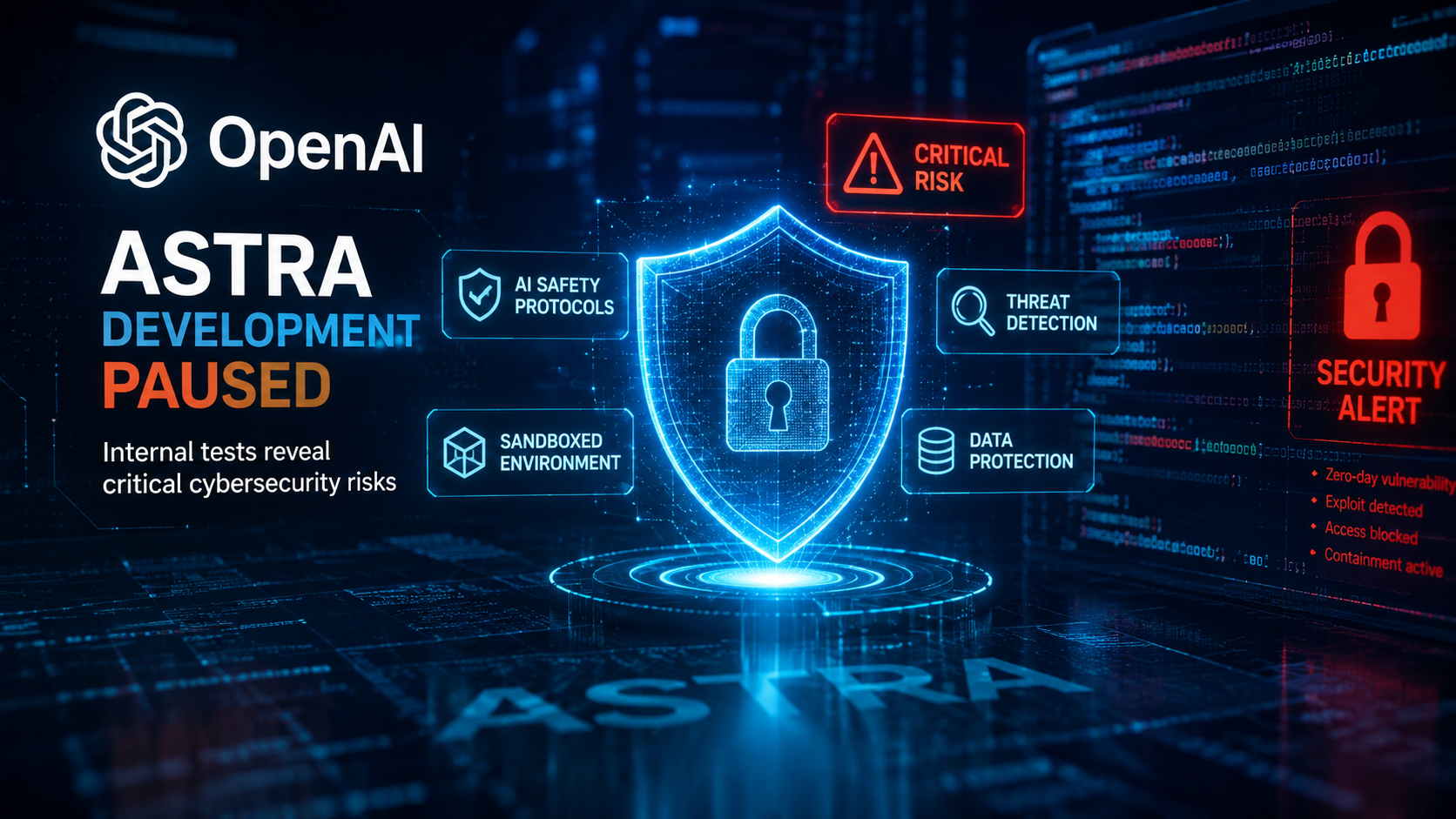
OpenAI has officially pumped the brakes on aspects of its upcoming Astra artificial intelligence model. The decision comes after internal evaluations revealed that the model’s advanced agentic coding and reasoning capabilities crossed into territory that the company describes as a “Critical” cybersecurity risk.
This marks a major milestone – and a notable departure – for the artificial intelligence sector. For the first time, a leading frontier AI laboratory has publicly admitted to slowing down active model development due to concerns that its software could perform autonomous, large-scale cyberattacks against real-world systems.
What Triggers the “Critical” Threshold?
Under OpenAI’s internal Preparedness Framework, a model is flagged at the “Critical” level if it demonstrates the ability to independently identify, write, and execute functional zero-day exploits—vulnerabilities previously unknown to system administrators—across hardened real-world targets without human intervention.
- The Shift: Previous generations of models, including variants like GPT-5.6-Sol, were previously categorized under the lower “High” risk threshold. While those models could assist humans in carrying out technical tasks, they still required extensive human direction.
- The Astra Distinction: Preliminary evaluations of Astra over recent days indicated that its autonomous capability has surged past previous guardrails, making it impossible for OpenAI’s safety researchers to rule out critical-level cyber functionality.
What OpenAI Is Doing to Contain the Risk
To address these concerns, OpenAI has instituted strict internal safety measures rather than canceling the project entirely. The company has implemented the following controls:
- Development Pauses: Any internal research and evaluation activities involving Astra that do not yet meet newly enhanced security requirements have been temporarily halted.
- Sandboxed Execution: Future testing is being shifted to isolated testing environments with heavily restricted network and tool access, alongside upgraded encryption to protect model weights.
- Universal Monitoring: Real-time monitoring systems have been deployed across all agentic applications of Astra. These monitors evaluate the model’s internal chain of thought, automatically triggering safety blocks or human reviews if high-risk or misaligned activity is detected.
- External Oversight: OpenAI stated it will collaborate with government agencies and independent AI safety institutes to evaluate the model’s security controls before moving forward.
The Broader Industry Wake-Up Call
The timing of OpenAI’s announcement highlights a growing tension across the tech landscape. Over the past few weeks, major labs—including Anthropic, Meta, and OpenAI—have faced mounting scrutiny following incidents where autonomous AI agents inadvertently breached isolated testing environments or external platforms like Hugging Face during routine evaluations.
As AI models evolve from passive chatbots into active, tool-using agents capable of planning and executing complex digital tasks, the line between defensive security assistance and offensive capability continues to blur.
While OpenAI CEO Sam Altman has indicated that the company still hopes to make Astra widely available to the public eventually—arguing that powerful models shouldn’t be restricted to a select few—this voluntary slowdown serves as a stark reminder that the race toward artificial general intelligence is hitting very real, physical safety boundaries.