
The real world use cases of blockchain technology in USA 2026 are expanding far beyond cryptocurrency. Many people now search “How is blockchain used in real life in 2026?” because the technology is being applied in multiple industries. From finance to healthcare and supply chains, blockchain is helping improve transparency, security, and efficiency. While adoption is strong in the USA and UK, its impact is becoming global including countries which are developing like India, South Africa, China, etc.
Real world use cases of blockchain technology in USA 2026
The real world use cases of blockchain technology in USA 2026 can be seen across different sectors. Blockchain is no longer limited to digital currency; it is now solving real problems in business and daily life. Companies are using it to store data securely, track transactions, and reduce fraud.
This shift shows that blockchain is moving from a theoretical concept to a practical tool used worldwide.
Blockchain in finance and payments
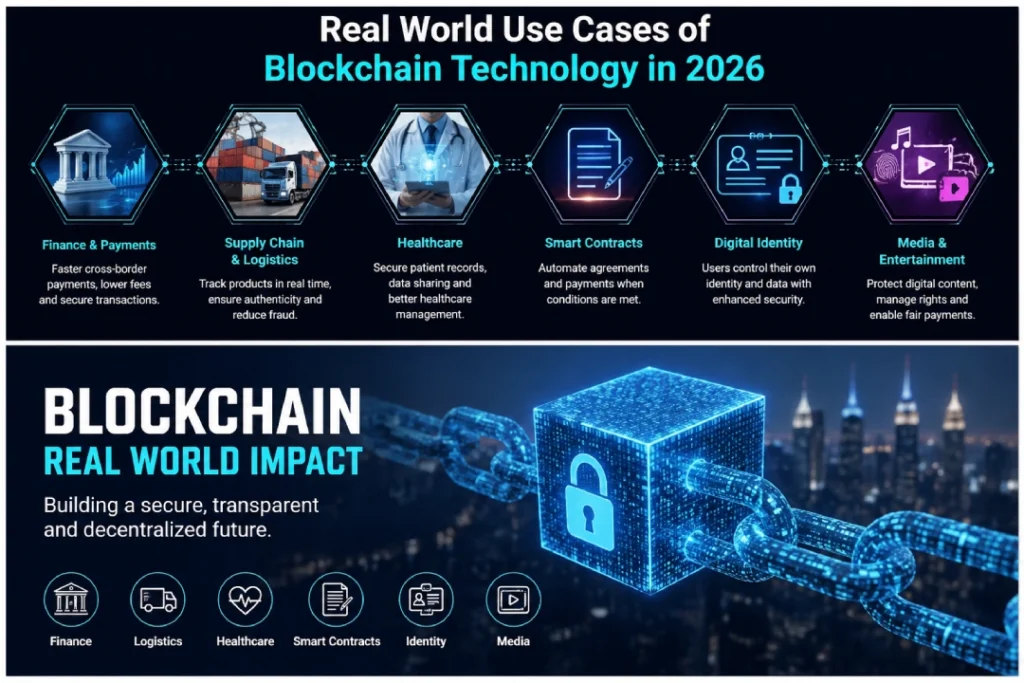
One of the most important real world use cases of blockchain technology in USA 2026 is in the financial sector. Banks and fintech companies are using blockchain to process transactions faster and more securely.
Traditional banking systems can take days for international transfers, but blockchain enables near-instant payments. It also reduces transaction costs and improves transparency. This is why many financial institutions are investing heavily in blockchain solutions.
Supply chain and logistics applications
Another key area for the real world use cases of blockchain technology in USA 2026 is supply chain management. Companies use blockchain to track products from manufacturing to delivery.
This helps ensure product authenticity and reduces fraud. For example, businesses can verify whether goods are original and track their journey in real time. This is especially useful in industries like food, pharmaceuticals, and luxury goods.
Healthcare and data security
The real world use cases of blockchain technology in USA 2026 also include healthcare. Hospitals and medical organizations are using blockchain to store patient data securely.
With blockchain, patient records cannot be easily altered, which increases trust and safety. It also allows secure sharing of data between healthcare providers, improving treatment and efficiency.
Smart contracts and automation
Smart contracts are another major part of the real world use cases of blockchain technology in USA 2026. These are self-executing agreements that run automatically when conditions are met.
They are used in areas like real estate, insurance, and legal agreements. For example, a payment can be released automatically once a contract condition is fulfilled, reducing the need for intermediaries.
Digital identity and security
The real world use cases of blockchain technology in USA 2026 also include digital identity systems. Blockchain can store identity data securely, reducing the risk of identity theft.
Users can control their own data and share it only when needed. This is becoming important as online security concerns continue to grow worldwide.
Cost and business value
The real world use cases of blockchain technology in USA 2026 are not just about innovation—they also provide financial benefits. Businesses can reduce operational costs by eliminating middlemen and improving efficiency.
Although implementing blockchain systems can be expensive initially, the long-term benefits often outweigh the costs.
Conclusion
The real world use cases of blockchain technology in USA 2026 show how this technology is transforming industries globally. From finance to healthcare and supply chains, blockchain is improving security, transparency, and efficiency.
As adoption continues to grow in the USA, UK, and other regions, blockchain is expected to become a standard part of modern digital systems. For businesses and individuals, understanding these use cases is important to stay updated with future technology trends.
Read More: Rocket Launch Today – Latest Updates, Mission Details